What Is Myopia and Why Is It Increasing?
Myopia (nearsightedness) is a refractive error where distant objects appear blurred while close objects are seen clearly. It occurs when the eyeball grows too long from front to back, causing light to focus in front of the retina instead of directly on it. According to the World Health Organization, myopia is rapidly increasing worldwide and is projected to affect nearly 50% of the global population by 2050.
In India, studies suggest that myopia prevalence among school-age children ranges from 5% to 20%, with urban areas showing significantly higher rates. The COVID-19 pandemic, with its increased screen time and reduced outdoor activities, accelerated this trend substantially.
Why does progression matter? High myopia (above −6 dioptres) is not just a matter of thicker glasses. It significantly increases the lifetime risk of serious sight-threatening conditions including retinal detachment, myopic macular degeneration, glaucoma, and early-onset cataracts. Slowing progression during childhood can dramatically reduce these long-term risks.
Understanding Myopia Progression
The eye grows rapidly during childhood and typically stabilises by the late teens. In myopic children, the eye continues to elongate beyond its normal length (measured as axial length). Each additional millimetre of axial length corresponds to approximately −2.5 to −3 dioptres of myopia.
Key risk factors for progression:
- Genetics: A child with two myopic parents has up to a 6x higher risk of developing myopia.
- Prolonged near work: Extended reading, tablet, and smartphone use encourages eye elongation.
- Insufficient outdoor time: Bright daylight exposure stimulates dopamine release in the retina, which inhibits eye elongation. Children spending less than 60 minutes outdoors daily are at higher risk.
- Early onset: Children who become myopic before age 7–8 tend to progress more rapidly and reach higher final myopia levels.
Proven Treatments to Slow Myopia Progression
-
💧
Low-Dose Atropine Eye Drops (0.01%–0.05%)
Atropine is a pupil-dilating drug that, at very low concentrations, slows the signal that drives excessive eye growth. The landmark ATOM (Atropine for Treatment of Myopia) and LAMP (Low-Concentration Atropine for Myopia Progression) studies showed that 0.05% atropine reduces myopia progression by approximately 50–60% over 2 years. Side effects at low doses are minimal — slight light sensitivity and minor near blur that most children barely notice. The drops are instilled once nightly at bedtime.
-
🌐
Orthokeratology (Ortho-K)
Specially designed rigid gas-permeable contact lenses worn overnight that gently reshape the cornea. The child wakes up with clear vision without needing glasses during the day. Studies show Ortho-K reduces axial eye growth by 40–50%. It is most suitable for children aged 8 and above with myopia up to −6 dioptres. Proper hygiene and regular follow-up visits are essential.
-
👓
Multifocal Contact Lenses & Peripheral Defocus Spectacles
Specialised lenses like MiSight (soft contact lens) and DIMS (Defocus Incorporated Multiple Segments spectacle lens by Hoya) are designed to correct central vision while creating a controlled amount of peripheral defocus, which signals the eye to slow its growth. Clinical trials show 50–60% reduction in myopia progression. These are worn during the day like regular glasses or contact lenses.
-
☀️
Increased Outdoor Time
Multiple large-scale studies (including the Sydney Myopia Study and the Guangzhou Outdoor Activity Trial) have conclusively shown that spending 90–120 minutes per day outdoors significantly reduces the risk of myopia onset and slows progression. Bright natural light — not exercise itself — is the protective factor, as it stimulates retinal dopamine release.
-
📚
Lifestyle Modifications
The 20-20-20 rule: every 20 minutes of near work, look at something 20 feet away for 20 seconds. Maintain a reading distance of at least 30 cm. Ensure adequate room lighting when studying. Limit recreational screen time to under 2 hours per day. These simple habits complement medical treatments and reduce eye strain.

Role of Myopia Control Glasses
One of the most exciting advances in myopia management is the development of myopia control spectacle lenses. Unlike standard single-vision glasses that only correct blurred distance vision, these specially engineered lenses are designed to actively slow down eye elongation while providing full visual correction for everyday use.
How Do Myopia Control Glasses Work?
Standard glasses focus light sharply on the central retina but allow light in the periphery to focus behind the retina (peripheral hyperopic defocus). Research has shown that this peripheral hyperopic defocus acts as a growth signal, encouraging the eye to elongate further. Myopia control lenses reverse this by incorporating zones of peripheral myopic defocus — they focus peripheral light slightly in front of the retina, sending a "stop growing" signal to the eye while keeping central vision perfectly clear.
Types of Myopia Control Spectacle Lenses
-
👓
DIMS Lenses (Defocus Incorporated Multiple Segments) — Hoya MiYOSMART
Developed by the Hong Kong Polytechnic University and manufactured by Hoya. The lens has a clear central zone for sharp distance vision surrounded by hundreds of tiny honeycomb-shaped defocus segments (+3.50D) across the mid-periphery. A landmark 2-year clinical trial published in the British Journal of Ophthalmology (2020) showed DIMS lenses slowed myopia progression by approximately 60% and axial eye growth by 60% compared to standard single-vision lenses. A follow-up 6-year study confirmed sustained efficacy.
-
👓
HAL Lenses (Highly Aspherical Lenslets) — Essilor Stellest
Essilor's Stellest lenses use a constellation of 1,021 aspherical micro-lenses arranged in 11 rings around the optical centre. These create a volume of signal in front of the retina rather than a single plane, providing a more robust myopic defocus. Clinical trials showed a 67% reduction in myopia progression over 2 years. The lenses look and feel like regular spectacles and are well-tolerated by children.
-
👓
DOT Lenses (Diffusion Optics Technology) — SightGlass Vision
These lenses use thousands of tiny light-scattering dots embedded across the lens surface (outside the central clear zone) to reduce retinal contrast in the periphery. Reduced contrast is believed to lower the stimulus for eye growth. Early clinical results from the CYPRESS trial showed a meaningful reduction in myopia progression. This technology is particularly useful for children who are newly diagnosed.
Why Choose Myopia Control Glasses?
- Non-invasive and easy to use: Worn like regular spectacles — no eye drops, no contact lenses, no special nightly routine. This makes them ideal for younger children (ages 6–12) who may not be ready for contact lens wear.
- Clinically proven: Multiple randomised controlled trials demonstrate 50–67% reduction in myopia progression versus standard single-vision lenses.
- Excellent visual quality: Children report clear, comfortable vision for all activities including reading, screen use, sports, and classroom learning.
- Can be combined: In cases of rapidly progressing myopia, myopia control glasses can be used alongside low-dose atropine drops for an additive slowing effect.
- No hygiene concerns: Unlike contact lenses or Ortho-K, spectacle lenses carry no risk of eye infections from improper handling.
Who benefits most? Myopia control glasses are recommended for children aged 6 to 16 years with progressive myopia (increasing by 0.50D or more per year). They are particularly well-suited for children who prefer glasses over contact lenses, younger children who need a parent-friendly solution, and as a first-line treatment before considering atropine drops or Ortho-K.
At Utsav Eye Clinic, we assess each child's myopia profile, rate of progression, and lifestyle needs to recommend the most appropriate myopia control lens. We can prescribe and fit DIMS, HAL, or other peripheral defocus spectacle lenses as part of a comprehensive myopia management plan.
What Does NOT Work
It is important to separate evidence-based treatments from common myths:
- Eye exercises and "vision training": There is no scientific evidence that eye exercises, eye yoga, or palming techniques can slow myopia progression or reduce the power of glasses needed.
- Under-correcting glasses: Some parents believe that weaker prescriptions will slow myopia. Research shows the opposite — under-correction actually accelerates progression. Always use the full, correct prescription.
- Delaying glasses: Not wearing prescribed glasses does not prevent myopia from worsening. It only causes the child to strain their eyes and perform poorly in school.
Myopia Control at Utsav Eye Clinic
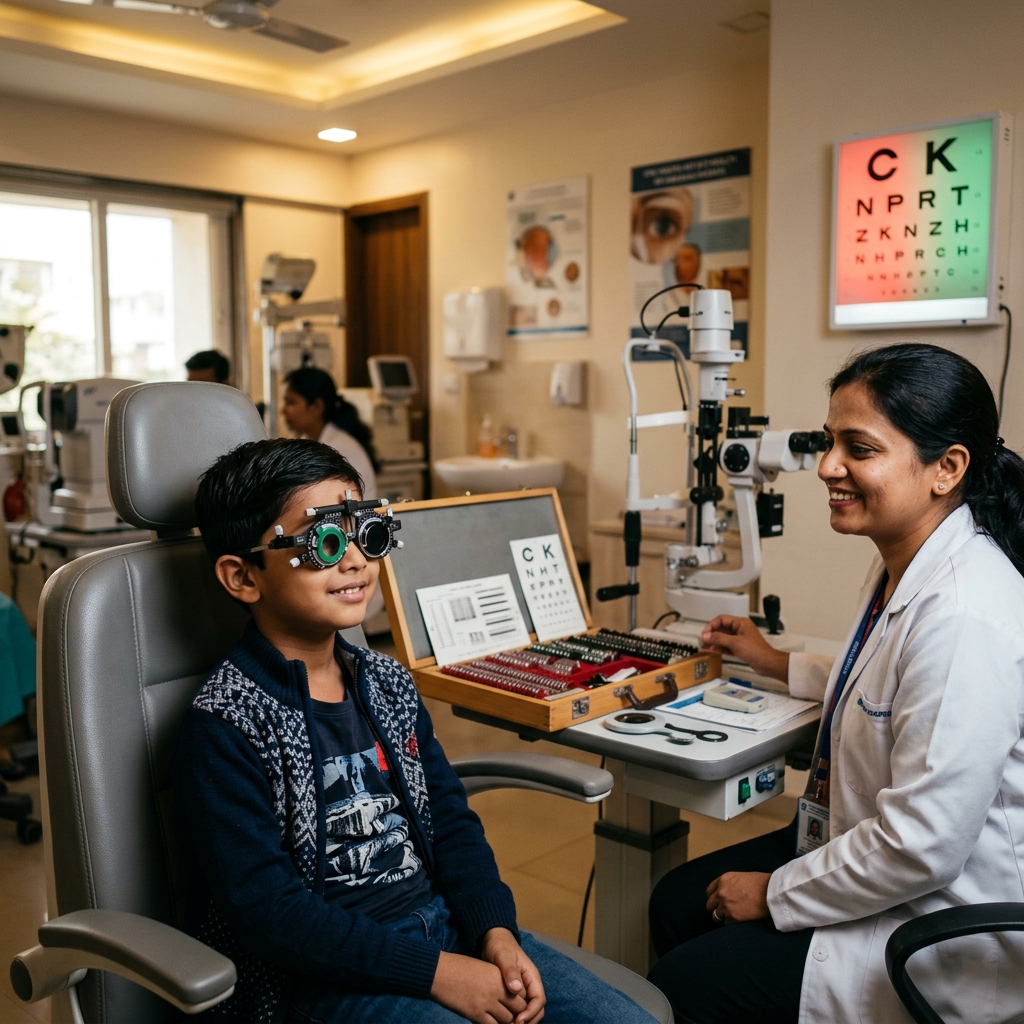
At Utsav Eye Clinic in Kharghar, Navi Mumbai, our myopia management programme includes:
- Comprehensive cycloplegic refraction to determine the true power of the eye.
- Axial length measurement to monitor eye growth over time — the most objective indicator of myopia progression.
- Customised treatment plans based on the child's age, degree of myopia, rate of progression, and family history.
- Regular follow-up visits every 6 months to track response and adjust treatment.
The earlier myopia is detected and managed, the better the long-term visual outcome. If your child's glasses prescription is increasing every year, book a myopia control consultation today.
Frequently Asked Questions
At what age should myopia control treatment start?
Treatment is most effective when started early, ideally between ages 6 and 12, when myopia tends to progress fastest. However, children and teenagers up to age 18 can still benefit from myopia control interventions. An ophthalmologist can assess whether your child is a good candidate.
Are atropine eye drops safe for children?
Yes. Low-dose atropine (0.01%–0.05%) has been extensively studied in large clinical trials spanning over 10 years. At these concentrations, side effects are minimal and may include slight pupil dilation and mild sensitivity to bright light. These effects are generally well-tolerated and reversible upon stopping the drops.
Can myopia be cured permanently?
Myopia cannot be "cured" in children because the eye has already elongated. However, the treatments described above can significantly slow down further progression, preventing the child from reaching high myopia levels. After the age of 18–20, once the eye stabilises, procedures like LASIK can correct the refractive error.
How often should a myopic child visit the eye doctor?
Children on a myopia control programme should be evaluated every 6 months. This allows the ophthalmologist to track changes in prescription and axial length, and adjust treatment accordingly. Children not yet on treatment should have at least an annual comprehensive eye examination.